Cascadia should follow North Dakota's lead and create public state banks
After a talk last night in Seattle by Bank of North Dakota CEO Don Morgan, I came away even more convinced that Oregon and Washington should make creating public state banks a high legislative priority.

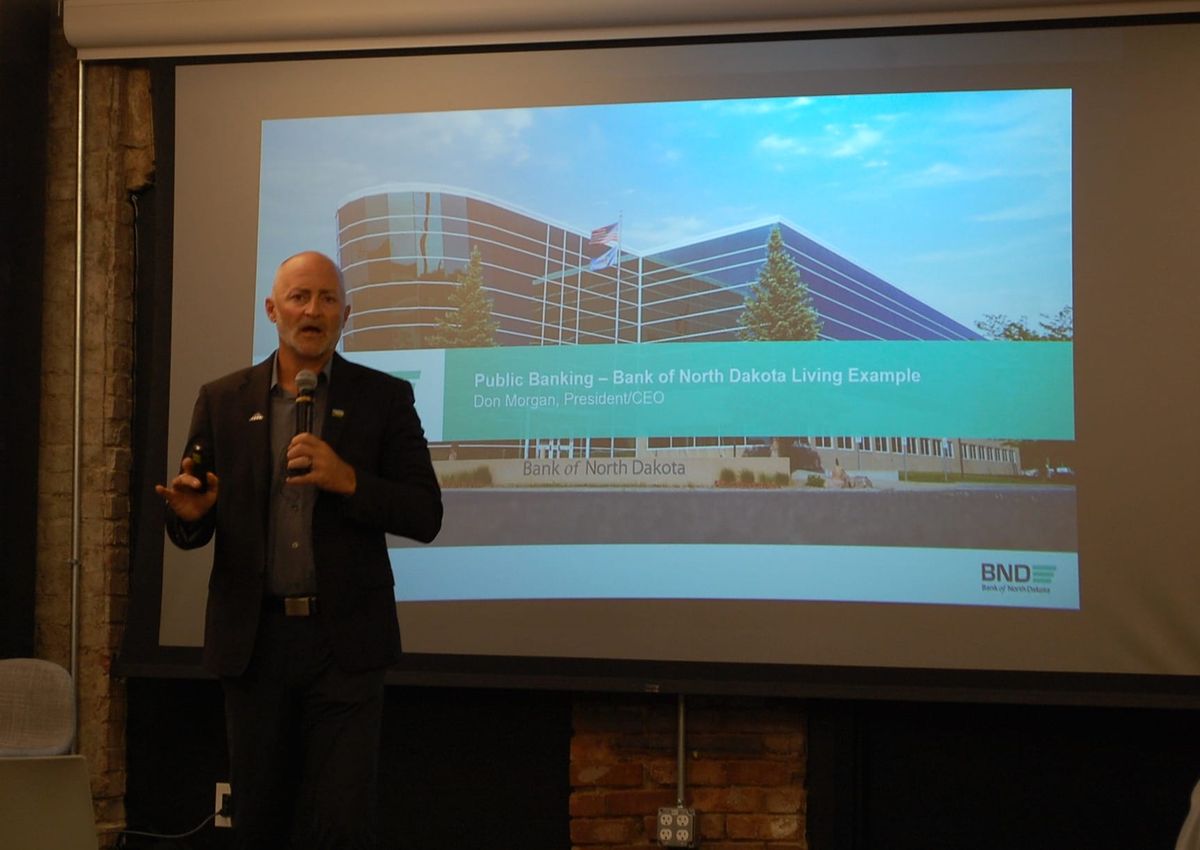
North Dakota, with about 800,000 residents, is a firmly red state where support for the GOP and Trump is still strong – and yet it's home one of the most progressive, populist financial institutions in North America: the Bank of North Dakota. Created in 1919 after farmers angry with an inability to get loans formed a new political party and took over state government, the Bank of North Dakota is the only public state bank in the US.
After a talk last night in Seattle by the bank's CEO, Don Morgan, I came away even more convinced that Oregon and Washington should make creating public state banks a high legislative priority.
The talk was sponsored by Washingtonians for Public Banking and it also featured a brief speech by Tiffani McCoy, interim CEO of the Seattle Social Housing Developer (SSHD), the nation's only social housing program, similar to those that have succeeded in Vienna, Austria.
"The housing crisis is so dire that having access to financing from a public bank would give us ample flexibility to build our pipeline, to be aggressive, and to meet the moment," McCoy said. "This would also tremendously help our affordable housing partners who are facing existential risks by the Trump administration's cuts on a daily basis."
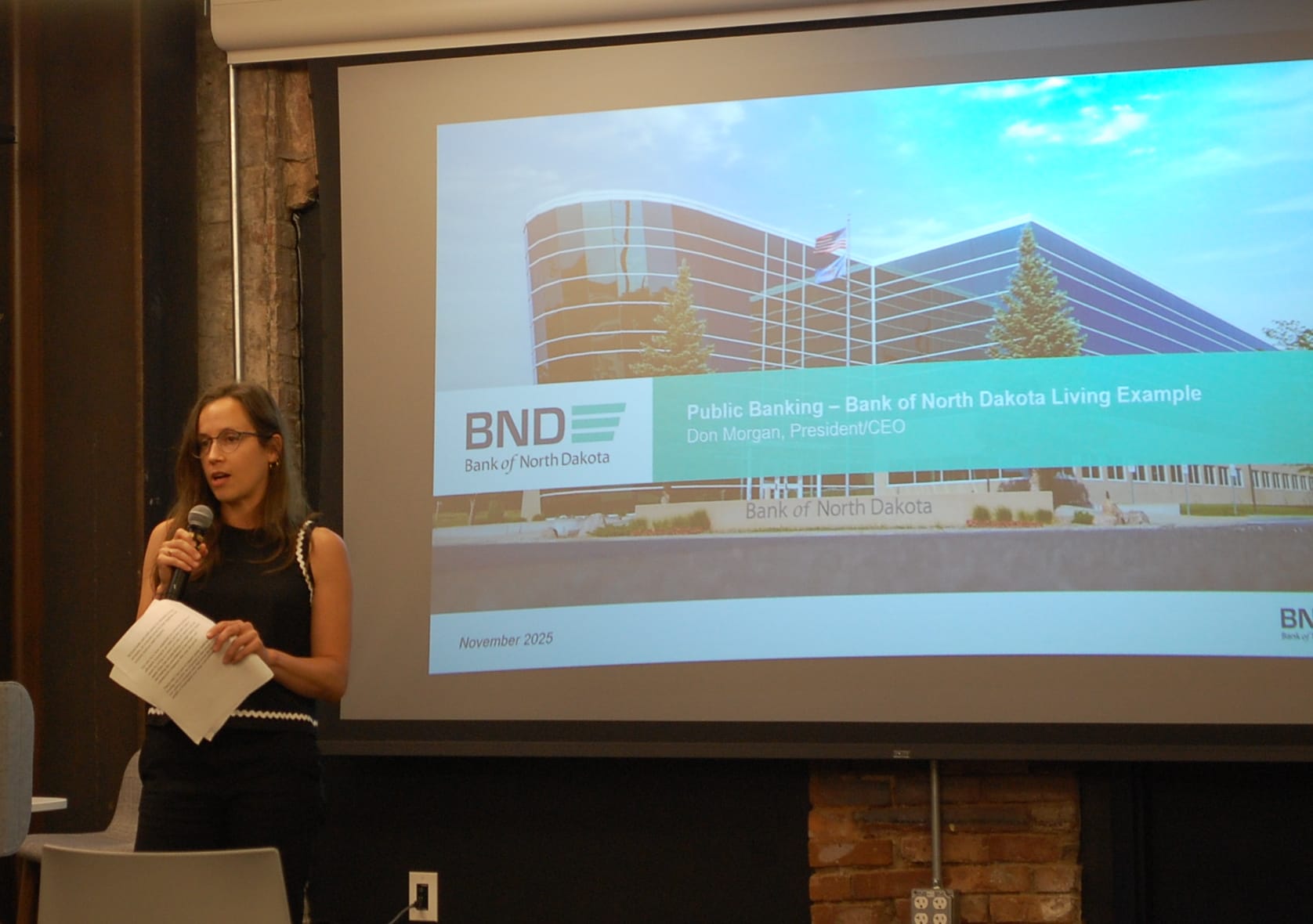
McCoy noted that in its first year, if a public state bank in Washington dedicated just one third of its loans to financing new housing in the state (about $3 billion) it would exceed in its first year the entire amount of financing the state's Housing Trust Fund has made available in its entire history, since 1986.
What exactly is a public state bank? And what does it do for North Dakota, and what could it do here in Cascadia?
"There's real power in owning your own bank,"
--Don Morgan, Bank of North Dakota
Morgan says the bank has a simple mission: to promote North Dakota agriculture, commerce, and industry. All income to the state is deposited in BND rather than with private mega banks such as Wells Fargo or Bank of America. BND has about $10 billion in assets and $2 billion in capital.
BND issues loans with that capital, working in partnership the state's small community banks and credit unions. The bank has always been profitable in its 107-year history and it in turn makes loans available to local business, individuals, and subsidizes low-interest rate loans (as low as 2%) for student college loans, disaster relief, clean energy transition, building schools, and other public benefits.
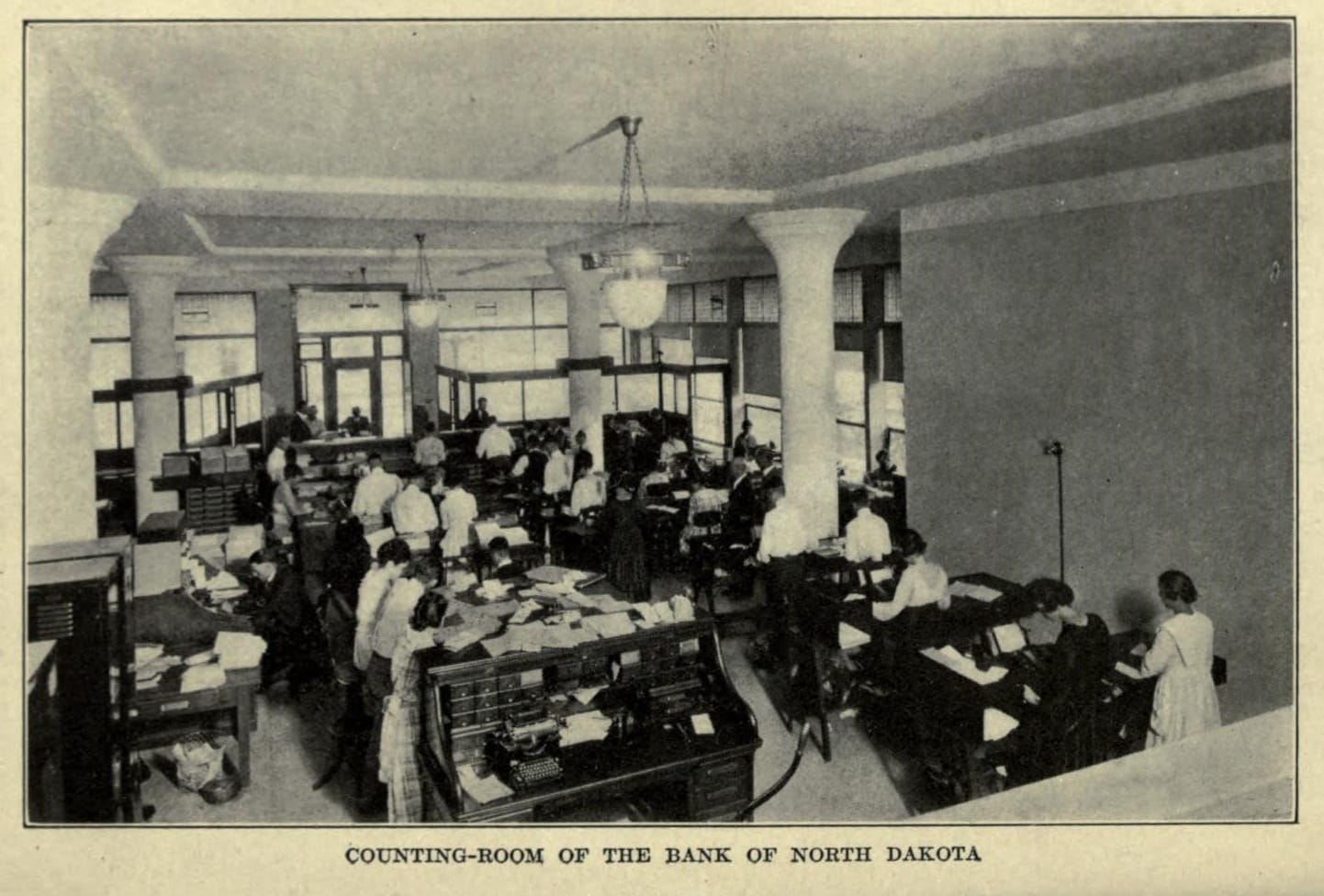
BND has some unique governance structures the prevent the legislature or governor from meddling in the bank's operation, which makes about $500 million in profit every year – funds that are then re-invested in the state rather than making huge private banks more profitable.
"I have to be able to look my board and my shareholders in the eye, and tell them your deposits are safe and they're liquid, and also I'm generating return on them and doing all the mission things that we want to do strategically as a state," Morgan said.
"There's real power in owning your own bank," Morgan noted.
Marco Rosaire Rossi, executive director of Washingtonians for Public Banking, agrees. His organization, which formally incorporated in 2022, pushes legislation creating a state public bank. Washington state senator Bob Hasegawa and others have introduced public bank bills every session since 2009, but none have passed. Last session, however, the legislature created a public banking work group, which will issue a full report next year.
Each of the public bank bills would create a state public bank that would hold all deposits from city, county, and state government, as well as local school boards.
Currently, about 60% of these current deposits – which toatal about $10 billion give or take $1-2 billion each year – are held by mega banks such as US Bank and Wells Fargo.
"Our argument is: why is the only thing we get for putting our money in those bank accounts a little bit of interest?" Rossi says. "We lose control over those monies as soon as we deposit them into a private bank." Rather than those funds being used for financial speculation or mergers and acquisitions, a public state bank would make them available for investments in Washington, Rossi says.
He agrees with McCoy that a public bank could be an immense help in addressing the state's housing crisis, which will require some 50,000 new units constructed statewide just to meet baseline needs.
In Oregon, the organization Oregon Public Banking Alliance advocates for a state public bank in Oregon. In 2023, the legislature passed HB 2763, which would have created a state public bank task force. Unfortunately, governor Tina Kotek, who's all about "prosperity councils" and other nonsense that doesn't actually help the state's economy, vetoed the bill.
Rossi says that creating a public state bank can also strengthen small banks and credit unions, which are focused on local needs, unlike Wells Fargo, which supports much of Trump's agenda.
"It would operate as a wholesale bank. So a wholesale bank is a bank that doesn't take accounts from private individuals," Rossi said. "A lot of the lending would occur through small community banks and credit unions throughout the state."
Morgan, in his talk, mentioned some of the Bank of North Dakota's recent successes, including subsidized loans to victims of flooding in and around Minot. The bank found that insurance and disaster relief were on average falling short between $30,000 and $50,000 of what homeowners needed to recover.
"We decided that, so these folks can start rebuilding their homes, we're going to do between $30,000 and $50,000 unsecured loans at 3% interest rates, and we're going to hope to hell they pay us back," Morgan said. "We did that seven years ago. We just got our last payments back last month. We had zero loss in that portfolio."
BND also makes student loans – the only loans it does directly to consumers. That's because most of the state's banks and credit unions are unwilling to get into the college loan market. All college students from the state or anyone attending a college in North Dakota qualifies.
All told, the bank provides about $1 billion in student loans, generates $500 million in profits (which it can then use to subsidize specially targeted loans), provides hundreds of billion of dollars in disaster relief loans, and supports loans for a little over $1 billion in state-directed programs (such as clean energy conversion).
The bank, in a thoroughly red state, even gave low-interest loans to farmers hit hard by Trump's tariffs.
"It's a very red state. They have a Republican governor," Rossi says. "But they have this 100-year-old institution was established in 1919 when the Nonpartisan League got control of the government and created this very progressive institution. And that institution to this day has bipartisan support."

Rossi also notes that in addition to returning investment to local communities, a Washington Public Bank could help address the state's increasing reserve fund crisis.
Because Washington legislators want to continue funding state services but have been reluctant to tax the wealthy and reform a very regressive tax system, they've been digging deeper and deeper into the state's reserves each year.
"We have the second lowest reserves of any state in the country," Rossi said (a report from the Washington Research Council says Washington's reserve is just 1.2% of general fund spending, second worst in the US). "That's why we are on the verge of having our credit rating drop because we're we're basically going to the bone, in terms of our reserves."
A lowered credit rating would mean higher borrowing costs, something that could be mitigated by a public bank.
"We have an asset out there, and that's our deposits." Rossi said. "It's an asset that we sell to these large banks for pittance. We can just reclaim that asset for ourselves and then use it to benefit our state."
To learn more about Washingtonians For Public Banking's campaign for a state public bank, visit their website. They're a small, grassroots org and could really use your financial donations or volunteer time.
Thanks for reading! As always, keep loving and keep fighting. --Andy
Do you appreciate Cascadia Journal's exclusive reporting on the ways the Pacific Northwest is pushing back against US fascism? If you have the means, please consider a paid subscription of just $5 per month. Each subscription helps me produce original reporting and opinionated notes on Cascadia's fight to build a more resilient and autonomous bioregion. And to those who already subscribe, thank you! --Andrew