Cascadia today: ICE kidnappings surge in Portland area + Walla Walla resists Amazon data center + Seattle boosts public restrooms
Share
Cascadia today: ICE kidnappings surge in Portland area + Walla Walla resists Amazon data center + Seattle boosts public restrooms
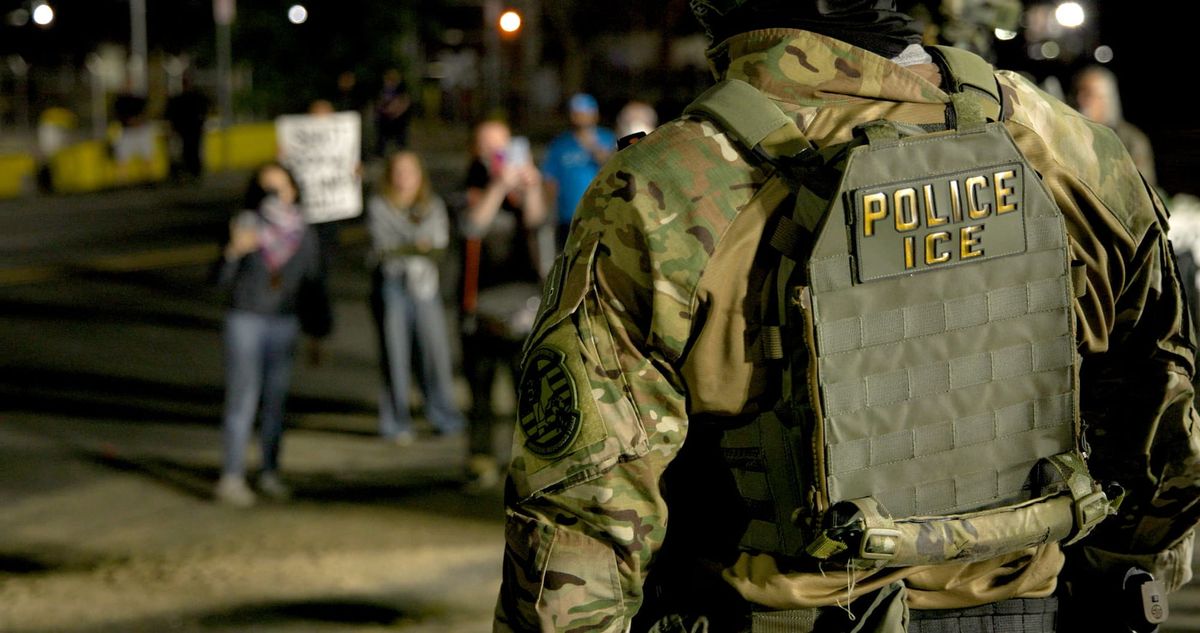
Immigrant activist groups report that ICE abductions are surging in the greater Portland area. Photo of ICE agents confronting protesters in New Jersey by ICE, public domain.

Good morning to everyone except ICE and their goons!

If you like reading this opinionated newsletter about Cascadia's pushback against fascism, will you consider helping me reach my goal of thirty new paid subscribers by the end of October? I'm still quite a few short of that, so help me out by pledging $5 or $10 per month to keep Cascadia Journal running. I can't do this without the generous support of my readers! Thanks! --Andy

Do you appreciate Cascadia Journal's exclusive reporting on the ways the Pacific Northwest is pushing back against US fascism? If you have the means, please consider a paid subscription of just $5 per month. Each subscription helps me produce original reporting and opinionated notes on Cascadia's fight to build a more resilient and autonomous bioregion. And to those who already subscribe, thank you! --Andrew

Support Cascadia Journal for just $5 per month

ICE abductions surge in Portland metro area

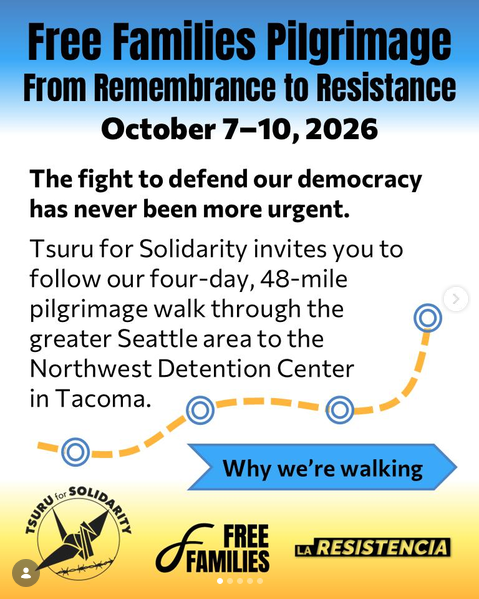
OPB reports that immigration activists are noticing a recent spike in ICE abductions in the Portland area. The Portland Immigrant Rights Coalition noted that at least nine people were kidnapped by ICE in Portland and its suburbs on Oct 6, for instance. In related news, members the Seattle area Japanese American community are making a multi-day march from the Seattle Chinatown International District to regional ICE facilities, ending with a rally and protest at the Northwest Detention Center in Tacoma. For more on the four-day, 48-mile pilgrimage calling for the end to the feds' cruel mass deportation effort, visit Tsuru for Solidarity's Instagram site.
Portland councilor trades in phone after court order

The Portland Mercury reports that Portland city councilor Dan Ryan traded in his phone for a new one the same day a Multnomah county judge ordered him to stop deleting messages that involve council business. The Mercury is taking Ryan to court to obtain public records of his text messages, especially those between Ryan and Brian Owendorff, after a journalist saw the local developer and conservative political operative exchanging racist and demeaning comments in a group chat that included Ryan during a council session in January. Do not vote for Dan Ryan.

Will BC economy win things for the NDP?

As British Columbia legislative elections shift into high gear, the Tyee reports on the state of BC's economy, which is pretty good compared to the rest of Canada. Though an unemployment rate of 5.8% (the best province except Quebec) sure seems pretty high compared to the rest of Cascadia (Washington's is 4.9% and Oregon is 5.1%). Early voting returns in Vancouver are already smashing records, CBC reports.

Walla Walla resists new Amazon data center

Washington State Standard reports on a growing movement in Walla Walla, Washington opposing a new, $4.8 billion data center Amazon is seeking to build 30 miles west of the city. This comes as Amazon earlier settled a lawsuit in nearby Morrow county in Oregon for $20 million after a data center contaminated groundwater with nitrates.

Seattle budget includes $1.4 for public toilets

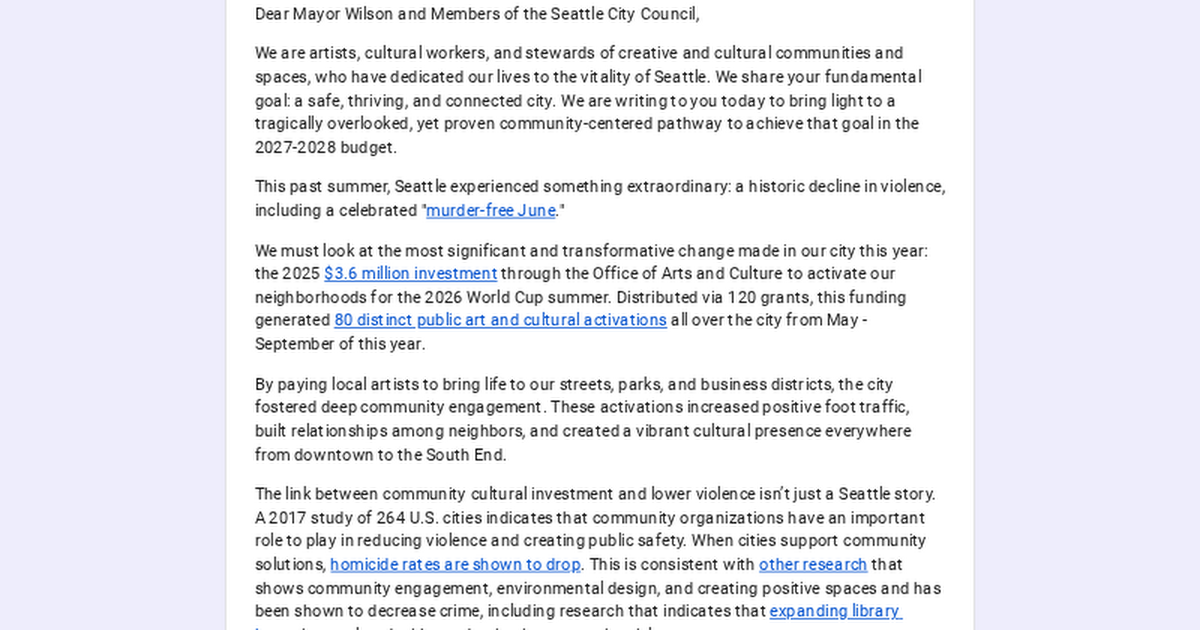
KNKX reports on a proposal in Seattle mayor Katie Wilson's budget that includes $1.4 million to increase the number of public restrooms across the city – including 10 modular restrooms created by Throne Labs. In related news, the South Seattle Emerald reports on public testimony during the debate over Seattle's proposed $9 billion budget, including a great proposal to take $8 million from the Seattle Police Department's half-billion-dollar budget for community arts programs. Sign on to the effort here:

Sign Open Letter: Seattle Art and Culture is Public Safety Infrastructure
SIGN ON BELOW AS AN INDIVIDUAL OR ORGANIZATION. Full text and list of signers here. --------- Dear Mayor Wilson and Members of the Seattle City Council, We are artists, cultural workers, and stewards of creative and cultural communities and spaces, who have dedicated our lives to the vitality of Seattle. We share your fundamental goal: a safe, thriving, and connected city. We are writing to you today to bring light to a tragically overlooked, yet proven community-centered pathway to achieve that goal in the 2027-2028 budget. This past summer, Seattle experienced something extraordinary: a historic decline in violence, including a celebrated “murder-free June.” We must look at the most significant and transformative change made in our city this year: the 2025 $3.6 million investment through the Office of Arts and Culture to activate our neighborhoods for the 2026 World Cup summer. Distributed via 120 grants, this funding generated 80 distinct public art and cultural activations all over the city from May - September of this year. By paying local artists to bring life to our streets, parks, and business districts, the city fostered deep community engagement. These activations increased positive foot traffic, built relationships among neighbors, and created a vibrant cultural presence everywhere from downtown to the South End. The link between community cultural investment and lower violence isn’t just a Seattle story. A 2017 study of 264 U.S. cities indicates that community organizations have an important role to play in reducing violence and creating public safety. When cities support community solutions, homicide rates are shown to drop. This is consistent with other research that shows community engagement, environmental design, and creating positive spaces and has been shown to decrease crime, including research that indicates that expanding library hours is correlated with a reduction in community violence. This summer proved a critical reality: art and cultural placemaking is public safety infrastructure. This is not merely an exercise in Crime Prevention Through Environmental Design (CPTED), it is also an active investment in healing. By resourcing existing creative networks, we are funding culturally relevant interventions that actively break cycles of violence. Artists and cultural workers are trusted messengers in their communities; when we fund their work, we are funding the social cohesion and collective care that true public safety requires. Decades of research demonstrate that per capita officers do not reduce violence in communities. A meta-analysis that included 62 studies and 229 findings of police force size and crime found that per capita staffing did not reduce crime rates and that “this line of research has exhausted itself” A 40 year systemic review with meta-analysis of the efficacy of CCTV - concludes “no significant effects observed for violent crime.” Yet, the proposed 2027 budget misses a critical opportunity to build on the successes the city has had in violent crime reduction. Instead, amidst a $175 million deficit, the budget proposes a staggering $68 million increase to the Seattle Police Department to add 66 sworn officers and continues the mass surveillance that is putting vulnerable community members in greater danger. We respectfully submit that such a massive expansion of the SPD budget is the wrong approach, particularly when the department is not suffering from a lack of resources, but rather from a bottleneck created by its own union’s policies. As the Inspector General’s August 2026 report clearly outlined, the collective bargaining agreement negotiated with the Seattle Police Officers Guild (SPOG) actively throttles the efficacy of our Community Assisted Response and Engagement (CARE) Department. By contractually prohibiting CARE from responding solo to incidents on private property or those involving substance abuse, and by granting SPD sergeants the power to veto CARE dispatches, SPOG has artificially manufactured an ongoing reliance on armed police for non-violent crises. We should not reward a system that deliberately limits our city’s alternative crisis response capabilities with an additional $68 million. Throwing more money at a structurally constrained system is not a sustainable safety strategy. We have a better model right in front of us. If we can fund community activation for FIFA and our summer tourists, we can—and must—do it for the people who call Seattle home year-round. Therefore, we respectfully request that the City Council amend the 2027 budget with the following action: Redirect $8 million from the proposed $68 million SPD budget increase into the Office of Arts and Culture (ARTS). Dedicate these funds specifically for 2027 grantmaking in creative placemaking and public art activations. This $8 million redirection is only a fraction of the proposed increase to the police budget, yet it allows us to more than double the 2025 investments in community led public activations that brought us the first murder free June in Seattle since the 1970s. By scaling up this highly successful “World Cup model”, we can transform these 80 summer activations into year-round, comprehensive safety infrastructure across all Seattle neighborhoods. This is not just arts funding; it is a direct investment in a proven public safety strategy. By beginning to value artists and cultural workers for the essential public safety infrastructure they provide, we can proactively build the healthy, vibrant, and safe neighborhoods that Seattle deserves without relying on constrained and overly expensive policing models. We have seen what works. Let’s fund it. Full text and list of signers here.

Chum News announces fiction editors

I'm really excited to see the Seattle-based online news, arts and culture site Chum News taking off. They do long-form journalism, essays, arts reporting, a regular column by a ferry worker, and now FICTION! The new editors for the fiction section are Amy Hirayama and Daniel Tam-Claiborne. Chum published a conversation with the two editors, check it out!

I'm really excited about experimental writing and people that are playing with genre and form and the boundaries and what is expected. I'm also excited about finding those voices and those writers in the city who have not really been in public quite as much. – Amy Hirayam, one of Chum News' new fiction editors

Thanks for reading! If you appreciate Cascadia Journal, please help me reach a goal of thirty new paid subscribers by the end of October. It's just $5 or $10 per month and it helps me continue to bring you this feisty, opinionated newsletter every day.

Do you appreciate Cascadia Journal's exclusive reporting on the ways the Pacific Northwest is pushing back against US fascism? If you have the means, please consider a paid subscription of just $5 per month. Each subscription helps me produce original reporting and opinionated notes on Cascadia's fight to build a more resilient and autonomous bioregion. And to those who already subscribe, thank you! --Andrew
Support Cascadia Journal for just $5 per month

Read more