Coast Salish Indigenous canoes inspire little poetry bookcases in Auburn & Muckleshoot land
Mateo Quispe, the poet laureate of Auburn, led the creation of little libraries of Indigenous poetry and placed them in community spaces across Auburn and Muckleshoot lands.

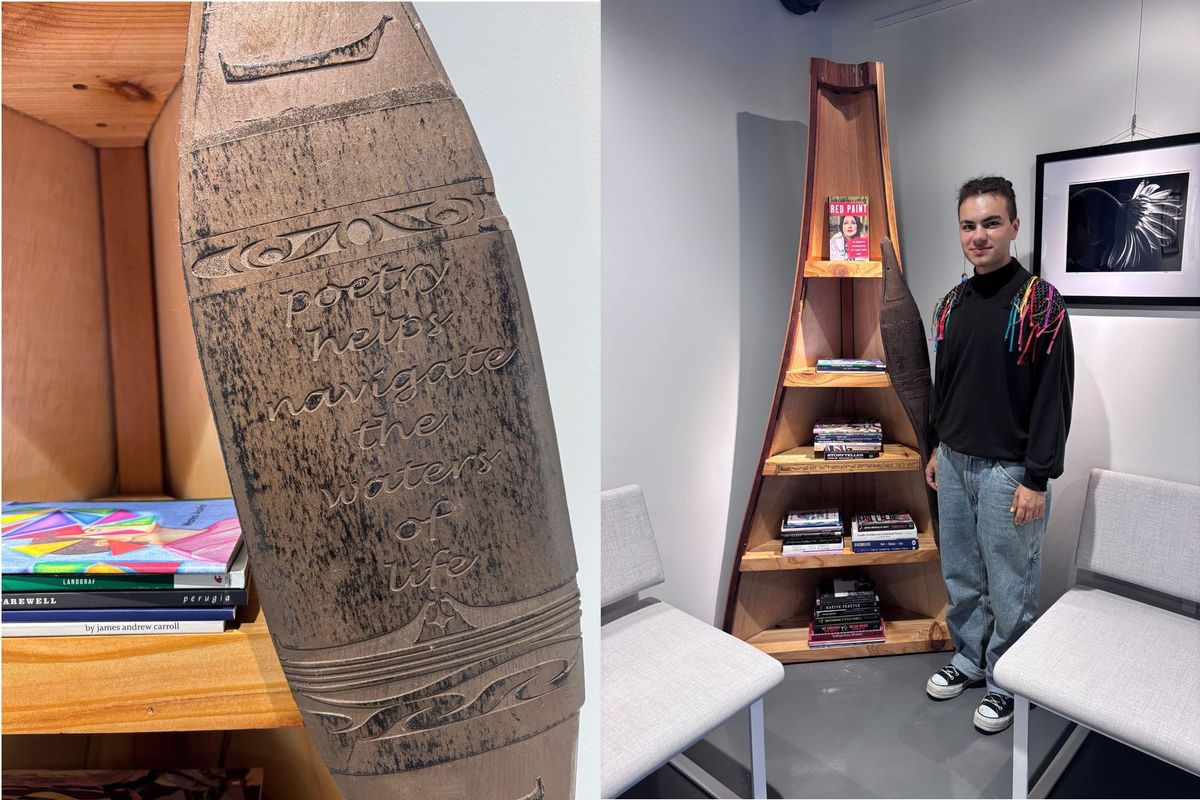
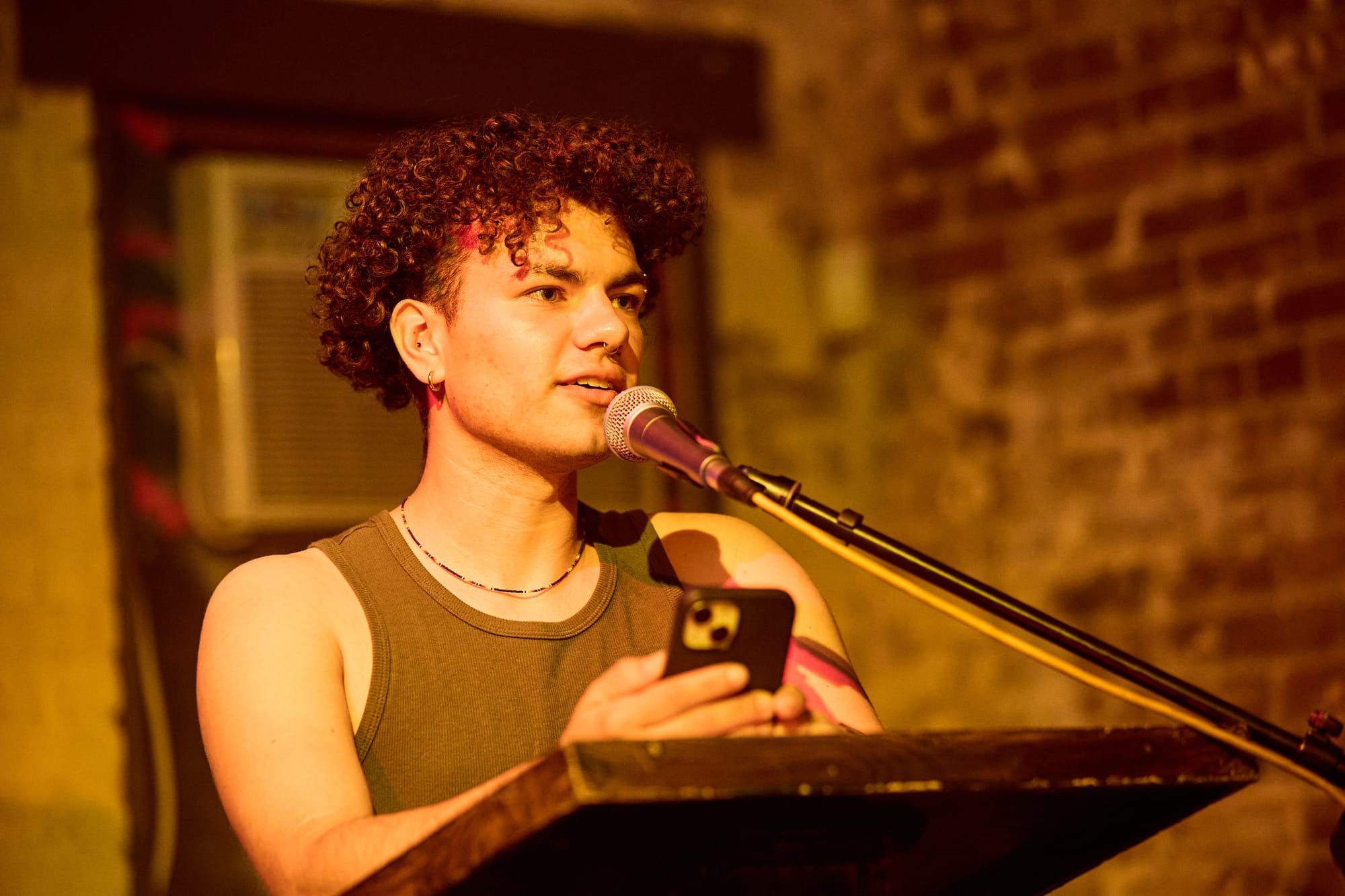
Mateo Quispe, who's the poet laureate of Auburn – a suburban city south of Seattle – wishes they'd had more access to Indigenous poetry growing up. Quispe spent most of their life in Auburn, and is Red River Métis and Little Shell Chippewa (unenrolled) as well as Two-Spirit Peruvian-American with Quechua heritage.
Now, at 23 they are the youngest poet laureate of Auburn (and one of the youngest poets to ever serve as a laureate in North America), and previously served as the Seattle Youth Poet Laureate. They decided to use their current position to secure grants to create little libraries of Indigenous poetry and place them in community spaces across Auburn and Muckleshoot land.
"I was walking and thinking about: why aren't these little free libraries having poetry? Why aren't people reading poetry?" Quispe says. "I wish people knew how cool poetry was. I'm going to the pond, I'm looking at the water, and then it all clicked. What if we did bookcases that look like canoes? Poetry helps navigate the waters of life."
"It's an invitation to slow down. You can put them in lobbies or other kind of spaces that are treated as non-spaces or liminal spaces, like waiting areas. You can transform those into places of peace and respite, and a chance to encounter some art."
The bookcases are inspired by Coast Salish canoe craft. Quispe's first exposure to Coast Salish canoe culture and protocol was being invited to participate in the University of Washington intertribal canoe family known as č̓away̓altxʷ ʔiišəd.
Quispe, who received a grant from the American Academy of Poets for the project, worked with carvers of the Muckleshoot Tribe – the reservation is located near Auburn – to create the elegant bookcases. Each also has a traditional paddle carved with inscriptions in Lushootseed (xʷəlšucid) – the language of the Muckleshoot – as well as English. The shelves are stocked with Indigenous poetry, memoir, and other writings by native authors.
"It's an invitation to slow down," they said. "You can put them in lobbies or other kind of spaces that are treated as non-spaces or liminal spaces, like waiting areas. You can transform those into places of peace and respite, and a chance to encounter some art."
After working with Postmark Center for the Arts in Auburn to create a proposal, Quispe reached out to Muckleshoot culture bearer Warren King-George for approval, since Quispe is not Coast Salish. "He said: you have good intentions, and so you just follow that." Quispe then worked closely with carvers Tyson Simmons and Keith Stevenson, who created seven bookcases.
The Lushootseed inscription can be translated several ways into English, Quispe said. "Good words show how to navigate the path of life," is the one, they said. "To decorate with words," is the another, they said, noting that this is "what poetry is."
Quispe encountered some bureaucracy trying to place the little libraries, once complete, in Auburn. They weren't allowed to be set up in Auburn public libraries, which Quispe says have "very strict codes" about what can be placed there. Auburn community centers also rejected the project, as well as the White River Valley Museum – "which would have been so important, because I think that museum really reinforces colonizer narratives, despite trying to include native history," Quispe said.
The Muckleshoot, however, cared little about bureaucracy and welcomed the project with open arms. The tribe agreed to put little canoe libraries in the Muckleshoot elders' complex, the community center, the cultural programming center, and the Muckleshoot tribal school. Other bookcases found a home at Postmark Center for the Arts, Auburn Senior Center, and Holman Library at Green River College (where Quispe got their associate's degree before getting a degree in the comparative history of ideas from the University of Washington).
In addition to exposing poetry to people who might otherwise not experience it, Quispe says the bookcases are a way to remind the people of Auburn about the Indigenous connection to the land and water here in past, present, and future.
"These bookcases are a reminder that we're on stolen Indigenous land, and that eventually the rivers will return. The settlement of the Auburn area is dangerous and impermanent," they said, noting that the flooding of 2025 killed several people and destroyed many homes. "There are so many dams. And they dredge so many rivers, like the White River, the Stuck River, and the Black River. That is not sustainable."
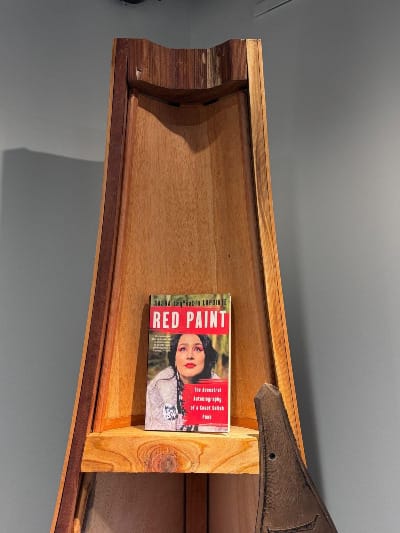
The shelves include many local Indigenous writers, including Sasha taqʷšəblu LaPointe, author of the memoir Red Paint, who's also the great granddaughter of er Vi taqʷšəblu Hilbert, a revered elder of the Upper Skagit Tribe who helped revive the Lushootseed language.
That counts as poetry, Quispe says, because Indigenous culture is infused with poetics.
"To me poetry in the greater context of our history. Our history as human beings is story, images, oral traditions," they said. "I see the bookcases themselves as an Indigenous poem, as Indigenous poetics, because they're communicating a message without words. Layli Long Soldier says real poems do not really require words. She also says everything is in the language we use."
"This will help you navigate the waters of life without even needing that inscription," Quispe said.
Quispe, who read at the Cascadia Poetry Explosion in May, is the author of the chapbook Dear Spanish (2024), creator of Blood Dawn of the Inti Sun, an Indigenous chamber opera developed through the Seattle Opera Creation Lab and based on the Andean Legend of the Ayar Brothers, and the forthcoming poetry collection Slaughter (Carbonation Press), about the history of Auburn, and being Auburn’s 2024-2026 Poet Laureate.
Thanks for reading. Have a great weekend! --Andy
Do you appreciate Cascadia Journal's exclusive reporting on the ways the Pacific Northwest is pushing back against US fascism? If you have the means, please consider a paid subscription of just $5 per month. Each subscription helps me produce original reporting and opinionated notes on Cascadia's fight to build a more resilient and autonomous bioregion. And to those who already subscribe, thank you! --Andrew