A conversation with Seattle writer Kristen Millares Young about her new memoir in essays
In lyric essays, Kristen Millares Young examines her lived experience as a woman, mother, and writer – while attempting to unmask patriarchy and reclaim human rights.
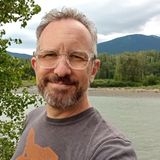
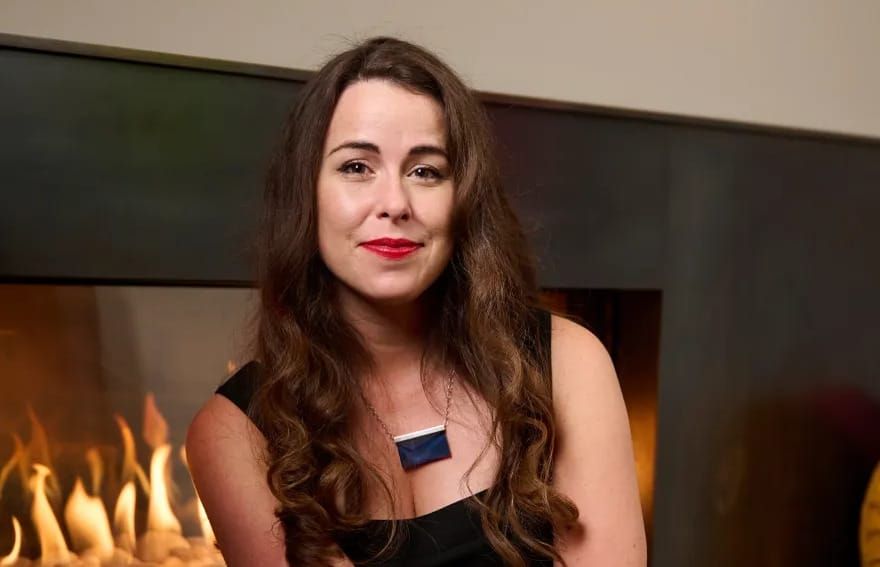
Seattle-based writer Kristen Millares Young has written a lot about Cascadia during her career as a journalist and novelist – having published scores of articles in the Guardian and The Seattle Post Intelligencer, was well as a novel set in the Pacific Northwest, Subduction. (Not to be confused with the new spoken word series with the same name!)
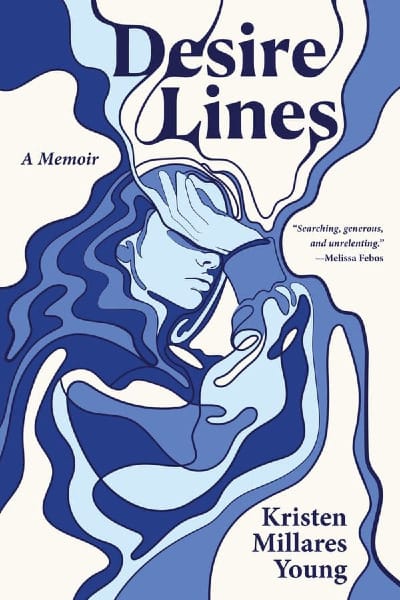
Now, Millares Young has decided take a more vulnerable leap and write about her own story. Her new debut memoir, Desire Lines, is told in a series of connected essays that explore her path through motherhood and her complicated relationship with her birth family. In lyric essays, she examines her lived experience as a woman, mother, and writer – while attempting to unmask patriarchy and reclaim human rights. Mythology sometimes serves as a touchstone, as Millares explores how the goddess cult of Cybele, for instance, offers a vision of women beyond the tired stereotypes of virgin or harlot.
The book's title refers to pathways created not by design but by the needs of people walking. This concept runs throughout the collection as Millares Young forges a new path as a mother, a woman, and a writer that defies the route that was planned for her.
I recently spoke with Kristen about her new book. If you'd like to read an essay adapted from Desire Lines, you'll find one at Literary Hub: To Become a Goddess: Kristen Millares Young on Motherhood and Marriage.
Millares Young will be appearing at Powell's Books in Portland in conversation with Vanessa Micale and Devon Fredericksen at 7 pm, Wednesday, October 28.
This conversation has been edited for concision.
Andrew: Why did you choose this format – a memoir told through essays – rather than just a straight memoir?
Kristen: I personally appreciate when a piece of writing, like a chapter, feels like it has been faceted into a jewel that you can hold in your hand. If you need to stop at that moment, if life calls you to get up and take care of something, or you need to sit with what you've just read and absorb it, then you can. The book will be there with you when you're ready to come back to it.
I find that our thoughts are so associative that people are able to take really large leaps without needing some of the hand-holding that commercial markets impose on books. So the essays are structured in an associative way internally, but there is an emotional logic and a series of revelations that create that forward momentum that compels someone to finish a book.
A: It's almost like you're you're you're giving a nod to to parents who have limited time, limited capacity. I feel like you can sort of dip in and then dip out.
K: I've always loved poetry collections. I dislike the Chekhovian model of a three-act structure that is oriented around conflict. I don't think that there is a real way for us to unmake the patriarchy of our society, while also orienting our storytelling around conflict. Ursula Le Guin in her book Steering the Craft writes about this. That prioritizing conflict within storytelling, which is the entire spinal column of the three-act structure – to do that prioritizes the worst aspects of our culture. There's seeking and knowing and discovering and these other ways of being and telling and showing and sharing that invite people in.
A: One of the really striking lines I saw in one of your essays, was when you said you'd written hundreds of articles and yet you'd rarely disclosed your own truth. How did that feel, why did you need to do this?
K: For a long time when people were objecting to the pretense of objectivity within newsrooms, they would point out – and it seemed like a very hard and fast line when I was on staff at a newspaper or when I was freelancing – that newsrooms require that third person authority. But that third person authority erases my own embodied knowledge, which is the deepest source of wisdom that I've ever had. And so, by accepting the authority offered by the third person, I often negated the wisdom provided by somatic experience, which is the only thing right now that privileges our humanity over artificial intelligence.
A: In that essay you you talk about how writing honestly about your personal experience was going to basically break off the connection with your birth family. Why was that necessary? It must have been difficult to make that choice.
K: In order to have a relationship, you need to have shared investment in each other's spiritual, emotional, and physical well-being. If there is a relationship that is contingent upon one of the member's happiness or safety remaining in a constantly compromised position, then that's not really a relationship based on mutuality or care. And so, when I realized that my happiness and well-being were not, and had never been valued by the people who are supposed to care about me most, that made it easier for me to allow them to have the consequences of their actions.
For many decades, I protected them against the consequences of their actions in the hopes that by doing so, it would give them time to evolve and transform and show love and show care. And instead, what I found was that I was creating the aperture for them to repeat abusive behaviors and to weaponize my own love against me, to keep me in a subordinated position that required my silence about the facts of my life.
Sometimes practicing radical acceptance with another person means saying: I believe that you are going to be as you are, and I accept you as you are. And because I accept that you are going to be as you are, you cannot be in relation to me. And now there needs to be a distance, as a self protection. You can forgive people while still operating in absentia.
A: For those of us who are parents, we're always basing how we parent in reaction to how we were parented. We always say: I don't want to do this. Or maybe: I want to be more emotionally available to my kids. How was your raising of your kids informed by your own childhood experiences?
K: I would say that I have the great good fortune to live with my children. I value when they tell me something. I try to listen. I'm not always able to provide the action that they need immediately, but I do try to listen and and show care in that way. That's opposite of disregard, right? It's an embrace and a welcome of their personhood.
Already at 11 and 12, they're introducing ideas and needs and paradigms that have completely upended my life. But I welcomed that into my life when I had children. I think there are some parents who think that children are going to be like furniture that they can just move around. They're there to serve as the function of the room rather than being the portal that opens up that room to the universe, the wind that blows everything around.
A: How is illness central to this book?
K: I don't know that it's illness that is central to this book, but it's the insistence on living. One of the things that happens throughout the book is that my body is surveilled in the name of keeping me healthy – and also in the name of maintaining my procreative abilities. And I, as a woman, have needed to engage the medical system to support my aim to live. But you also put yourself at the mercy of it, at the mercy of that surveillance, and its timelines, and its anxieties, and its depression.
To the extent that illness is a thread in the book it's because both of my parents have had cancer, and I myself have had a series of borderline tumors, the last of which I actually cut loose from my body in 2024. I would say that these pinternal threats compel us to reevaluate what's important, and by re-evaluating that importance, you then have to act on that knowledge. It's when you think that you might die soon, and in pain, that definitely reorients you toward life, being in the present. Being with your kids, enjoying a good meal, walking through a forest, smelling the air. Getting off these damn screens.
A: How is place rooted in this book, whether it's here in Washington or elsewhere as you're talking about your experiences?
K: To me, place is embodiment. Place calls for us to be present, and it's one of the reasons that architecture is such an art form. It's one of the reasons that people often find a sense of well-being in a forest, or by a river, or by the sea. It's not simply a geolocation. It is a sensory embrace of sound and texture and smell and color and taste, even. There's nothing more delightful to me than when the maritime fog will make its way over Beacon Hill, and I can actually feel the sea, which doesn't often present itself here in the valley as much as it would if I were living closer to the coast.
As a writer, that's the embodied feeling of being in a place. To evoke that in writing is, in some ways, to call people back into into their bodies and into the world, even though they're reading something.
A: Yeah, that's the magic of it, right? You can, if you've had that experience before in your own body, you can kind of know it, feel it. It's like reading someone's mind or reading their body, in a way.
K: It is magic. You're using markings on dead trees to make someone have a shared hallucination with you.
A: Is there something in this book that you really want to highlight or talk about that I've missed?
K: Sometimes when we're striking out on a desire line it feels like a divergence from the path, but the divergence is the path. That's hard to recognize sometimes.
A: For me personally having gone through a divorce, it felt awful at the time, and it felt like I didn't want to go on that path. But it was clearly the path, and it was the right path. Often you don't know that until later, in hindsight.
K: Right? That's the thing, and it's really hard. It's really hard to accept that knowledge. It's a cyclical. It's a cyclical knowing. It's a recurrent instruction.
A: Do you feel like mythology helps you with that? You keep coming back to these mythic figures. Is that part of it, that it's a reassurance?
K: I think we can find meaning in stories, whether or not we believe they are true, and so mythology has crystallized human yearning for meaning in a way that supersedes the number of centuries between when the story was first told and when it's received. And we see that in religion, which is the human art of answering mystery. And for those of us who are agnostic or secular, there is a stripping down of mystery sometimes from the frameworks that are provided. But I think there's still so much to be had, and gleaned, and harvested, and sown from these stories. Not the least of which is that beneath the paradigm of impossible purity that virgin motherhood connotes, was a fierce and destructive and sexual goddess who rolled with lions.
A: That's such a better myth, right? The boring virgin versus the one who's tangling with the lions.
K: Right? One of the essays is called "It Was Dark in the Womb." And it recounts my experience of going to the Louvre and visiting their archives. And I couldn't bring my kids into the archives. While I'm visiting the archives I was allowed to view their pagan mother goddess art so I could study motherhood. But I couldn't be a mother within the institution. And afterwards I'm bringing my kids through the hallways and the galleries of the Louvre, and it's just centuries upon centuries of virgin worship. I mean, it's enough to give you a headache. It was just painful, because the only other depictions of women in that museum were naked women who were representing Eros.
I was recently at MoMA and saw a painting called "Woman Reading," by Lucie Cousturier. It's an impressionist painting, not quite pointillism, but with these short brushstrokes that, in aggregate, create an image. It was so lovely to see a woman reading. I was just so taken with that depiction of a woman as an agent of thought.
Do you appreciate Cascadia Journal's exclusive reporting on the ways the Pacific Northwest is pushing back against US fascism? If you have the means, please consider a paid subscription of just $5 per month. Each subscription helps me produce original reporting and opinionated notes on Cascadia's fight to build a more resilient and autonomous bioregion. And to those who already subscribe, thank you! --Andrew