As feds hold back disaster funds to Cascadia, tax gap grows to $51 billion
Cascadia – Oregon and Washington together – paid $51.5 billion more in taxes than were returned back to our region in funding in 2025.

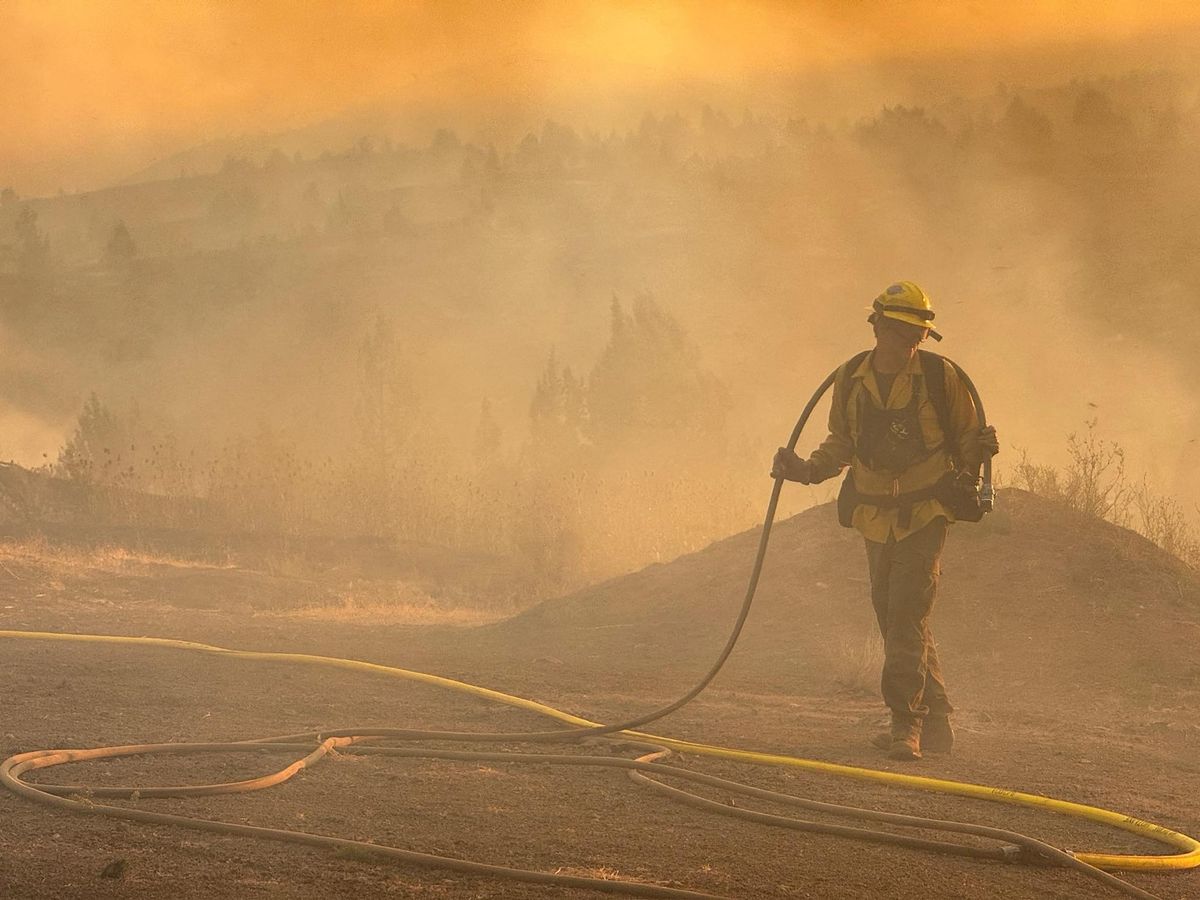
This week the Trump administration denied two of five FEMA wildfire assistance requests from Oregon, which is confronting what will likely be the most destructive wildfire season in its history. More than 1 million acres in 86 active fires have already burned. The denials of funding prompted a letter from the state's two Democratic senators, Ron Wyden and Jeff Merkley, saying the move is evidence of "a major shift in administrative policy." The two fires that didn't qualify for assistance have already burned 320,000 acres.
This comes as Politico published a detailed article on how Donald Trump personally rejected disaster aid requests to four states – all Democratic-majority – even though FEMA staff recommended honoring the requests. Trump has denied the vast majority of disaster funds requests from Democratic states. Last year, FEMA rejected Washington's request for tens of millions of dollars in damage from a "bomb cyclone" storm that hit the state in the fall of 2024. No reason was given for the denial.
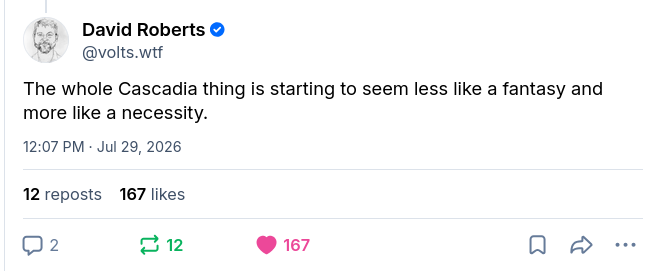
This news about the recent politically-motivated FEMA aid denial prompted environmental journalist David Roberts to conclude in a post on Bluesky that "The whole Cascadia thing is starting to seem less like a fantasy and more like a necessity."
I've been noting for more than a year that together, Oregon and Washington pay $36 billion more in federal taxes than they receive back in funding and services to our region every year. That was based on a USA Facts article using data from fiscal year 2024.
From what I've found in the latest data from fiscal year 2025, Cascadia's tax gap has grown even worse.
The USA Facts article has not yet been updated to analyze 2025 data, and I can't say for certain what their methodology is for determining the gap/surplus for each state. But they wrote that in 2024, Washington state paid $57 billion more in federal taxes than it took in. Oregon had a net gain of $21 billion more in services than it paid in taxes, so the net balance for our two states was negative $36 billion in 2024, before Trump took power.
Looking at IRS data for FY 2025 broken down by state, I found that Washington paid $158.8 billion in total federal taxes. Oregon paid $39.4 billion.
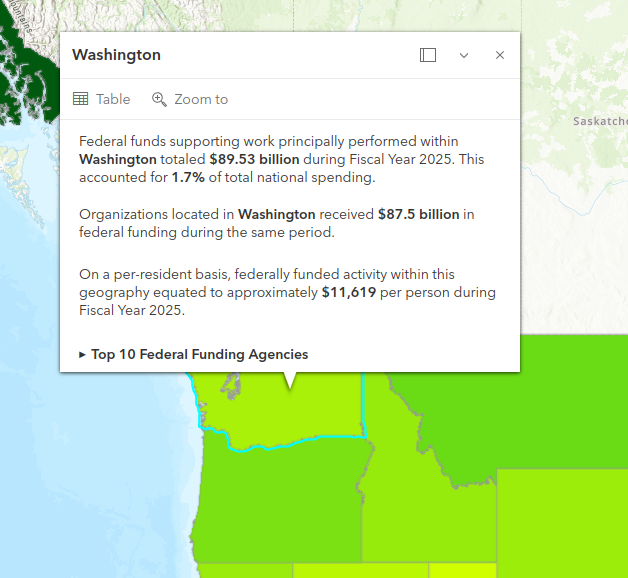
Next, according to an excellent state-by-state data map of federal spending in FY 2025 by Laura Phoebus at ESRI (based on data from USAspending.gov), the federal government spent $89.5 billion in Washington state and $57.2 billion in Oregon in FY 2025.
That means that in 2025, Oregon received $17.8 billion more in funding than it paid in federal taxes last year, which is down from 2024.
The most shocking figure is for Washington.
In 2025 Washington state paid $69.3 billion more in federal taxes than it received back in funding – a 21 percent jump in the tax gap over the previous year.
This means that Cascadia – Oregon and Washington together – paid $51.5 billion more in taxes than were returned back to our region in funding in 2025.
I've said it before, and I'll say it again: if we in Cascadia want things like universal health care, free college tuition, a well-funded education and child-care system, a functioning safety net that leaves no one hungry, and reliable disaster relief, we're going to need to gain fiscal and political independence from the United States.
 Andrew Engelson
To put that $51 billion figure in perspective, to create Medicare for All in Oregon and Washington would likely cost Cascadia about $80 billion a year. (That's based on our region's percentage the US population (about 3.5 percent) and thus our share of a recent cost estimate of $2.3 trillion per year for the US.
Merely keeping that $51 billion in excess federal taxes we pay every year here at home would get us more than halfway to a universal health care system for Cascadia.
I agree with David Roberts – separation is feeling more and more like a necessity.
Do you appreciate Cascadia Journal's exclusive reporting on the ways the Pacific Northwest is pushing back against US fascism? If you have the means, please consider a paid subscription of just $5 per month. Each subscription helps me produce original reporting and opinionated notes on Cascadia's fight to build a more resilient and autonomous bioregion. And to those who already subscribe, thank you! --Andrew