How the New Democrats lost BC
After calling an early snap provincial election in British Columbia because he sensed the BC Conservative Party was in disarray and betting he could connect the MAGA-style conservatives to Trump, Eby and the NDP ended up losing very badly.


This past weekend, premier David Eby and his centrist New Democratic Party discovered the perils of underestimating your opponent.
After calling an early snap provincial election in British Columbia because he sensed the BC Conservative Party was in disarray and betting he could connect the MAGA-style conservatives to Trump, Eby and the NDP ended up losing very badly.
The NDP went from a narrow 47-seat majority in the legislature to just 27 seats, with conservatives capturing 67. The BC Greens improved their vote percentage to 11% and held two seats, including one for the 26-year-old party leader Emily Lowan. The conservatives took 48% of the vote, and the NDP 47%
One obvious lesson from this election, which had the lowest turnout of a BC provincial election since 1949, was that BC could avoid a lopsided assigning of seats by switching to proportional representation.
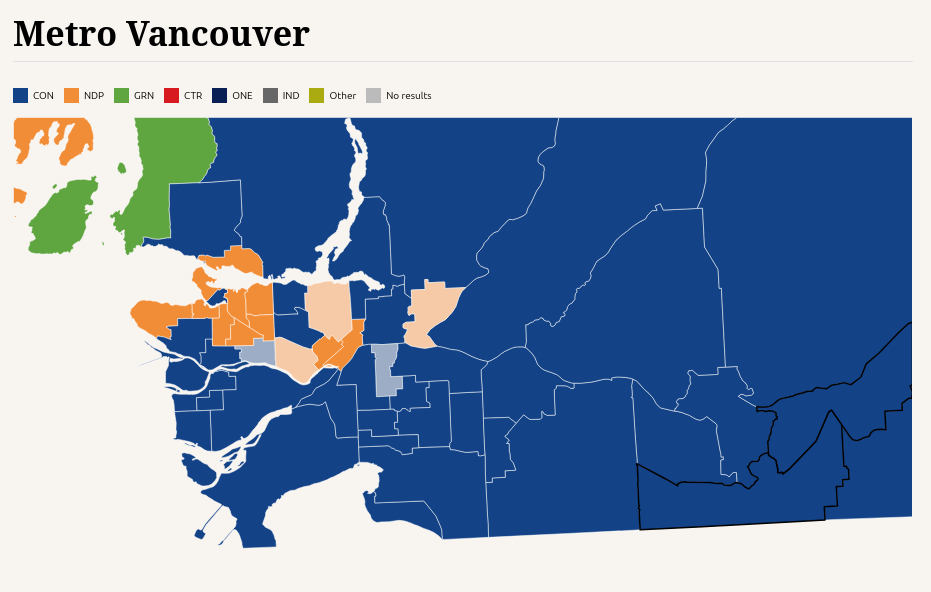
Eby, who resigned as leader of his party after the embarrassing defeat, managed to barely retain his seat in the legislature. However, many NDP legislators lost their seats, especially those in Vancouver's southern and eastern suburbs. According to CBC, six ministers in Eby's cabinet lost their elections, including Anne Kang, who represents Burnaby and who was formerly minister of tourism.
Kang's loss was part of larger trend: battleground suburbs shifting from the NDP to the conservatives. According to analysis from CBC, conservatives flipped ridings in Richmond and Surrey and even won in several Vancouver ridings, including Vancouver Fraserville and Vancouver Yaletown. This is especially striking when you consider that just a week prior, Vancouver voted out mayor Ken Sim and nearly all councilmembers in Sim's centrist ABC party. The winners were the Greens and the democratic socialist party COPE.
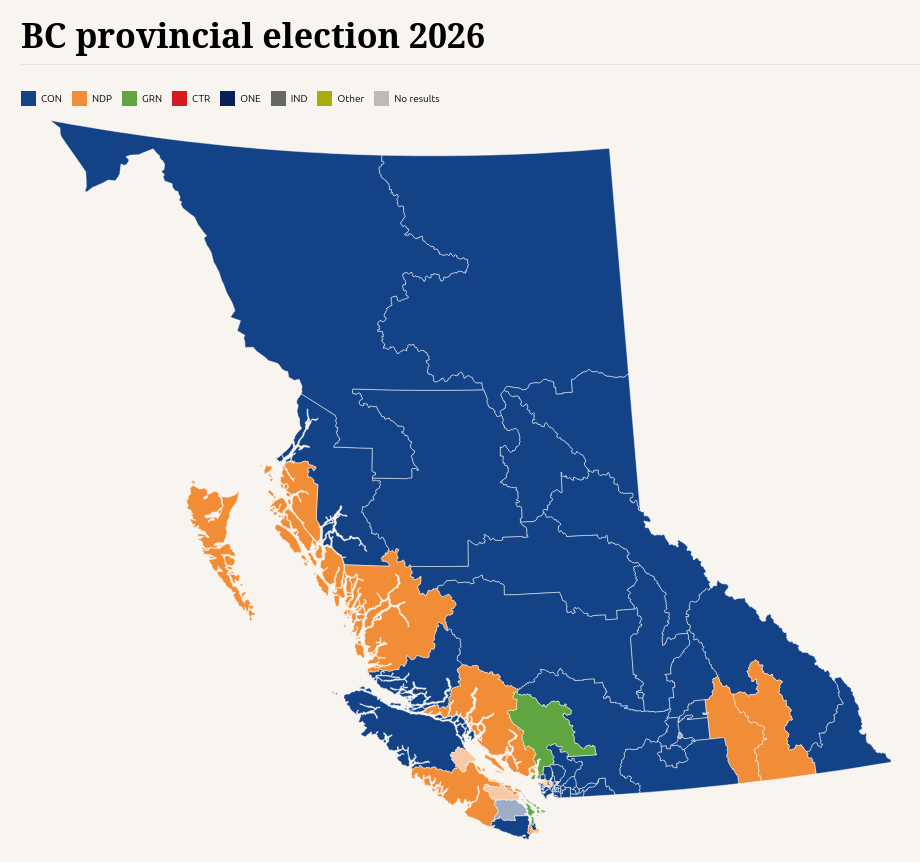
It was a province-wide rout for Eby and the NDP, and one driven by just 48% of registered voters bothering to turn out.
Eby had warned that a vote for the BC Greens would lead to a conservative victory. And, according to CBC returns, 12 ridings had a total of NDP and BC Greens votes that was more than the conservatives. But even if they'd won all those seats, it wouldn't have been enough to gain a majority.
The NDP had hoped to run a campaign associating the conservatives with Trump, who is deeply unpopular in British Columbia. Unfortunately, Eby didn't have prime minister Mark Carney's knack for making use of Canadian patriotism. And the election ended up being a referendum on the status quo: high gas prices, high rents, and unemployment fueled a desire to toss out incumbents.
And the NDP has only itself to blame for losing BC Greens voters. Its center-right policies on fossil gas exports, its tepid opposition to a new pipeline from Alberta, its lackluster attempts to protect old growth forests from logging, and its backsliding on climate commitments discouraged Green voters from switching.
And the NDP's middle-of-the-road policy on Indigenous issues, including weakening DRIPA (the requirement that the legislature consult with and gain consent from First Nations) didn't win it many votes. And now the conservatives are vowing to repeal DRIPA.
In the aftermath of this defeat, it's important to note that the BC Greens were the only party to actually make gains in their share of the vote: they gained about 30,00 votes while the conservatives lost about 20,000 and the NDP lost 228,000. The Greens held on to two seats: party leader Lowan took East Saanich and the Islands, and Jeremy Valeriote retained his seat in West Vancouver Sea to Sky.
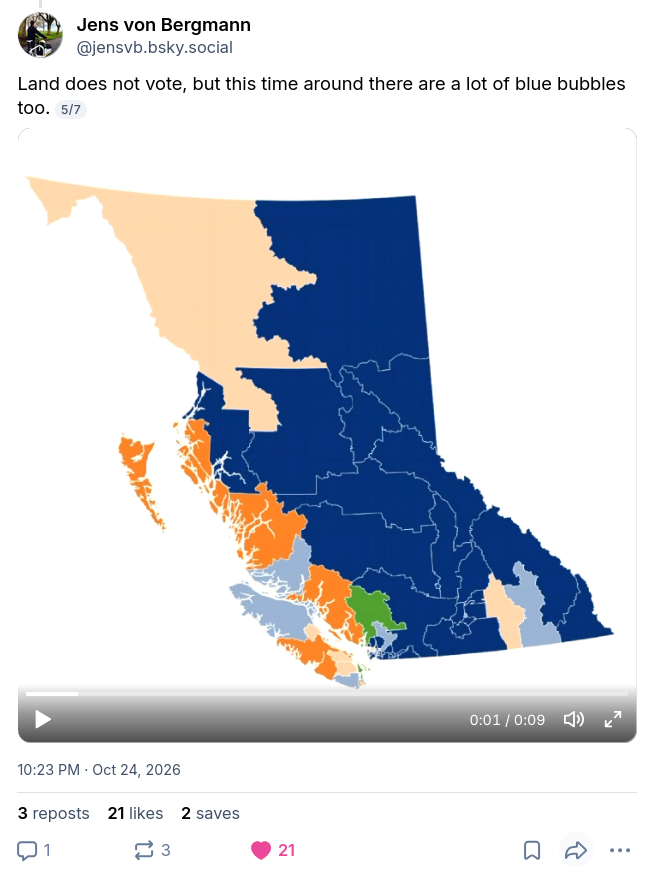
Mountain Doodles, a data visualization project from Vancouver's Jens von Bergmann, has created some fantastic interactive graphics on the recent election, including this animation posted to Bluesky:
As progressives make gains across North America, with Zohran Mamdani winning as mayor of New York, Katie Wilson, a socialist, winning in Seattle, and Pete Fry winning Vancouver, centrist parties like the NDP are losing relevance. One has to ask: in the search for votes in the center, how much are you abandoning young, progressive voters who see climate change and affordability as key issues?
Washington governor Bob Ferguson and Oregon governor Tina Kotek (who's in a very tight race) would do well to learn the lesson that endlessly trying to court center-right voters is a mug's game. It wastes political capital and doesn't actually lead to electoral victory. Voters want bold, effective solutions, not timid baby steps.
As a result of the NDP loss, BC's environment will likely suffer in the short term. The conservatives have vowed to end a ban on oil and fossil gas tankers on the north BC coast. They've made noises about protecting old growth forests, but also bragged about "getting more fibre on trucks." They support Mark Carney's proposed new climate-killing pipeline from Alberta to BC. They'll likely limit the expansion of Indigenous Protected Areas and have pledged to boost destructive mining.
Oh and they've vowed to cut taxes and curtail harm reduction efforts like safe supply, which has saved thousands of lives in BC.
This is a big setback for progressives across Cascadia who believe that a strong economy is compatible with climate action, environmental protection, a strong social safety net, and an empathetic drug policy. It's going to be a long four years as environmental groups and First Nations file lawsuits, and opposition lawmakers point out flaws in the BC conservatives' policies.
Thanks to the NDP's lack of opposition to Canada's feds, Washington will likely see more tankers in the Salish Sea and Straight of Juan de Fuca, increasing the risk of oil spills and endangering whales. It will be more important than ever to think bioregionally.
And as Quebec increasingly moves toward separation, and Alberta's MAGA-style secession movement isn't quite dead yet, BC may find itself very soon considering joining the progressive Cascadia separatist movement in Oregon and Washington as the map shifts in North America.
If the conservatives start logging old growth in BC as the Trump regime hopes to do south of the 49th parallel, look for a new, noisy environmental movement to grow across Cascadia. We built blockades, we've camped high in trees, and we invented the term monkey-wrenching. As wildlife biologist Rachel Holt recently told the Tyee, if the conservatives ramp up clear cuts, "“it will push us back to an era of public civil disobedience."
Welcome to the fight, British Columbia.
Do you appreciate Cascadia Journal's exclusive reporting on the ways the Pacific Northwest is pushing back against US fascism? If you have the means, please consider a paid subscription of just $5 per month. Each subscription helps me produce original reporting and opinionated notes on Cascadia's fight to build a more resilient and autonomous bioregion. And to those who already subscribe, thank you! --Andrew