Why is REI acting more like a corporation than a co-op?
Faced with several years of profit losses, REI co-op has started to act like a typical profit-hungry corporation.

I've been a member of Recreational Equipment, Inc. (REI) since the late 1980s, when I first climbed Tahoma (also known as Mount Rainier) as a college student. At the time, it was a scrappy, member owned co-op on Capitol Hill that sold climbing and hiking gear you couldn't find anywhere else.
Since then, REI, which is now based in Kent, Washington, has grown to become North America's largest consumer co-op and the largest retailer of outdoor gear in the US, with 195 stores and robust online sales.
But, faced with several years of profit losses, the co-op has started to act like a typical profit-hungry corporation. It has engaged in union-busting and discouraged employees – known affectionately as "green vests" – from joining unions. Twelve REI stores, including one in Bellingham, WA have unionized. In response, the co-op has refused to present an acceptable offer to workers at unionized stores and instead gave raises to workers at its non-union stores.
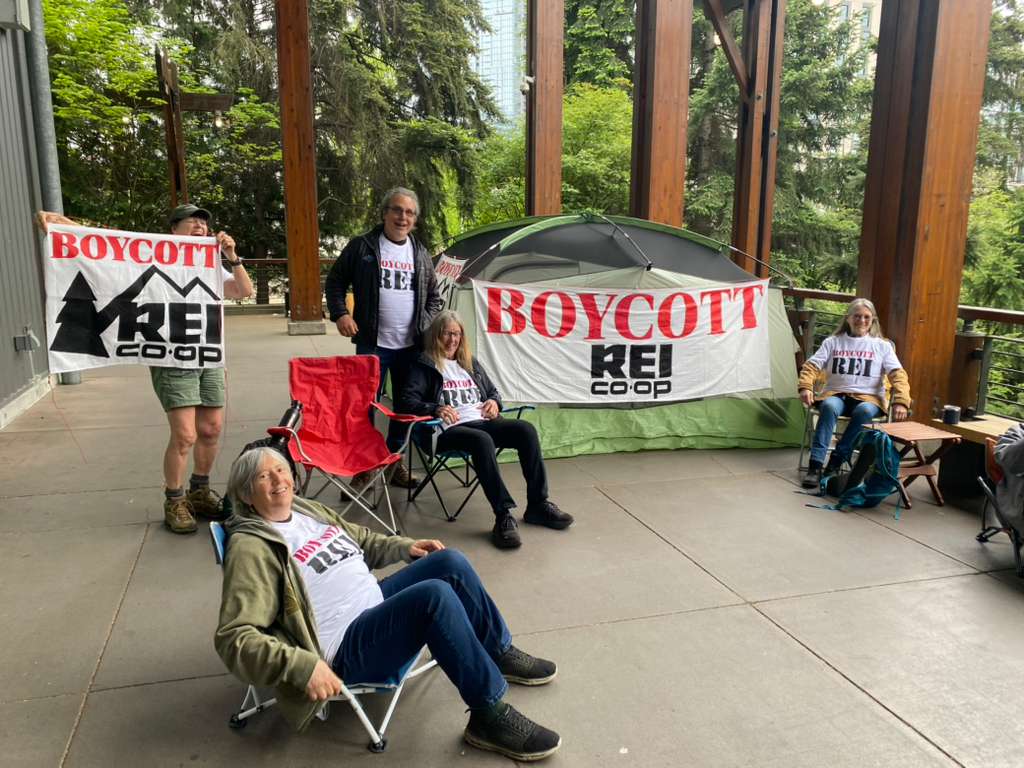
In response, unionized REI workers teamed up with 70,000 co-op members fed up with REI's corporate behavior who pledged to boycott REI during its biggest sale of the year in mid May.
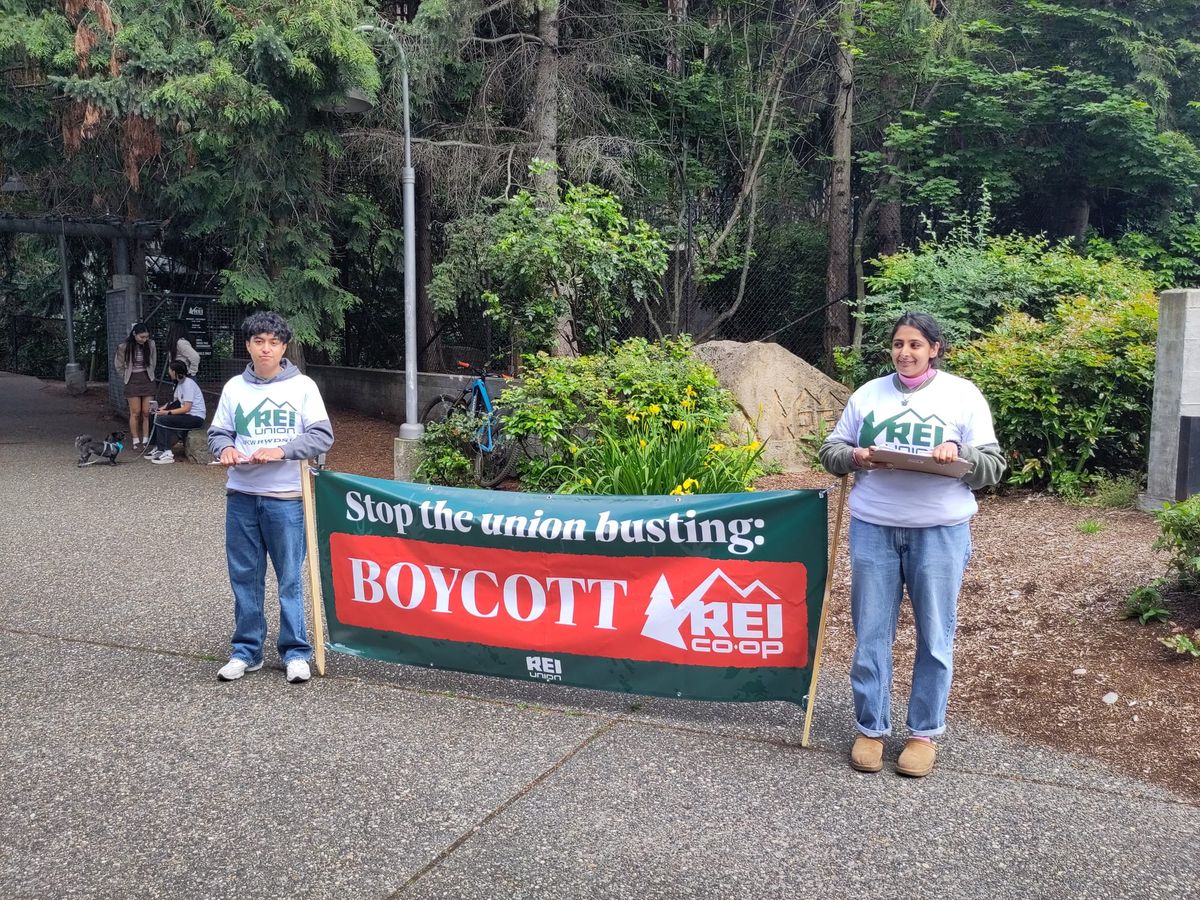
Include me as one of those annoyed members. In response, I showed up at the Seattle flagship store in May to hand out flyers and convince other shoppers to boycott REI – until the co-op offers workers a fair contract and stops union busting.

I was there alongside members of UFCW 3000, the union representing green vests in Washington, as well as some other longtime co-op members pissed off at REI. While I was there, a co-op member named Ben unfurled a banner from the massive climbing wall inside the store. And later that week, Seattle police arrested a co-op member who was camped out at the Seattle store in support of REI workers.
The boycott comes at pivotal point for consumer co-ops in Cascadia. Created to serve the needs of members rather than generate profits for corporate shareholders, these organizations are finding business difficult in late-stage capitalism. Seattle-based grocery co-op PCC has also had labor struggles and board conflicts.
"They shouldn't shy away from workers asking to have a voice in their workplace, which is shocking," says UFCW 3000 spokesperson Rich Smith. "PCC, REI – these are local, homegrown Seattle co-ops that trade on that progressive image but act like big box conservative companies at the bargaining table."
Last year, after a campaign to add two union-supporting members to REI's governing board, REI changed its by-laws to allow for un-elected appointments to the board.

Smith says REI has engaged in a rigorous anti-union campaign, lying to workers about unions, hiring the notorious union-busting $1,000/hour law firm Morgan Lewis (one of whose former attorneys is now top attorney at the Trump regime's National Labor Relations Board) and offering a contract that forbids further unionization at other stores.
That contract included slim wage increases, elimination of a "working vacation" time off policy that allowed green vests to test the gear they sell, and a non-disparagement clause. "That's so anything that an REI worker says in public about REI that could be perceived of as negative would be grounds for removal or firing," Smith said.
In a statement on its website, REI said "REI came prepared to bargain in good faith and to discuss the topics and proposals on which the parties remain apart. Unfortunately, the parties were unable to reach an agreement."
Of the boycott, it said, "This is a disappointing move that targets the co‑op. It seems the union’s focus is on harming the financial well-being of the business, instead of advancing negotiations."
Some of the 70,000 co-op members who pledged to join the boycott disagree.
“I’m proud to have stood alongside REI workers during this year’s Anniversary Sale and not shop,” said Margo Polley, a co-op member in Seattle. “I was shocked to hear about the treatment of workers. REI is supposed to be the good guys."
Do you appreciate Cascadia Journal's exclusive reporting on the ways the Pacific Northwest is pushing back against US fascism? If you have the means, please consider a paid subscription of just $5 per month. Each subscription helps me produce original reporting and opinionated notes on Cascadia's fight to build a more resilient and autonomous bioregion. And to those who already subscribe, thank you! --Andrew